【Part 1】Collaboration with Fairy Devices Inc. Achieves Worksite DX: Behind the Scenes of Award-Winning Project for Innovation
NEWS
【Part 1】Collaboration with Fairy Devices Inc. Achieves Worksite DX: Behind the Scenes of Award-Winning Project for Innovation
FEATURE
2024.10.04
Daikin Industries is advancing HVAC service through worksite DX using video and audio AI in collaboration (※1) with the University of Tokyo venture, Fairy Devices Inc. (※2). By combining Fairy Devices' smart wearable device "THINKLETⓇ" with its proprietary business support web app, Daikin aims to develop a remote support solution where experienced engineers can remotely support and educate less experienced engineers in outlying locations. In Part 1 of this article, we speak with Fairy Devices' CEO, Masato Fujino, and Daikin (TIC) members Rei Kondo, Yuko Kouzuki, and Yoshinao Inaba on the background for this project, which won the 5th Japan Open Innovation Award (Minister of Internal Affairs and Communications Award) (※3), together with its development objectives and various episodes.
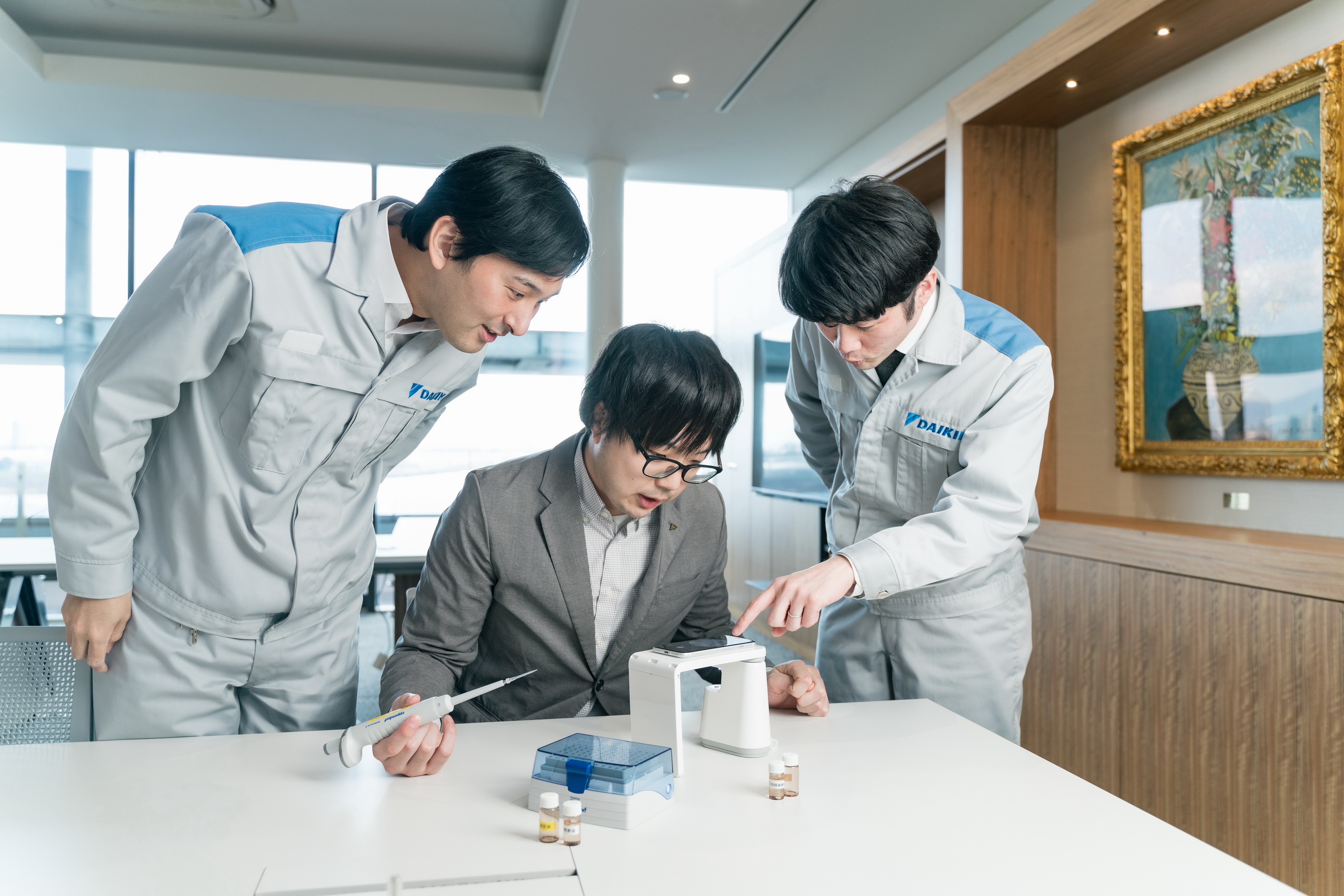
(From left in the photo)
・Yoshinao Inaba
Responsible for new applications of smart wearable devices other than remote support and for expanding overseas markets.
・Masato Fujino
President and CEO of Fairy Devices Inc. Responsible for overseeing the entire project, including technical aspects.
・Yuko Kouzuki
Responsible for developing the on-site remote support system and conducting research and development to analyze video and audio using AI technology.
・Rei Kondo
Initiated the project and expanded it across departments. Responsible for venture collaborations.
Challenges of HVAC On-Site Service Operations and Significance of the New Project
――What made you initially decide to start this project?
Kondo: The HVAC market is expected to triple by 2050, with electricity demand also tripling. In the context of decarbonization, demand for energy efficiency is increasing. This makes energy conservation all the more necessary, particularly in light of the trend toward carbon neutrality. To maintain both the energy efficiency and quality of HVAC units, improving the after sales service operations, such as installation and maintenance inspections, became essential. Daikin Industries operates as a comprehensive global air conditioning manufacturer with business operations in over 170 countries, more than 110 production sites, and about 100,000 employees. To achieve both decarbonization and economic growth, quickly securing highly skilled service engineers in various countries is an urgent task.
In emerging countries where market growth is expected, there is a need to quickly develop service personnel with skills in HVAC equipment, whereas in Japan, issues including the transference of skills and labor shortages have materialized as skilled engineers retire in an aging society with a declining birthrate. In this project, we aimed to utilize DX technologies that could contribute to solving global issues such as skill improvement and labor shortages.
――Was there something unexpected that led to the collaboration with Fairy Devices?
Kondo: Yes. When Daikin established a comprehensive collaboration agreement with the University of Tokyo, I became responsible for venture collaboration, and I was encouraged by Senior Executive Officer Yuji Yoneda to meet "someone very interesting." That person turned out to be CEO Masato Fujino (laughs). That was the starting point of this project. After hearing him speak for the first time, I was amazed by Mr. Fujino's overwhelming vision and wide range of technical knowledge. We hit it off immediately, and I knew that I wanted to collaborate with him on a project. Later, when I heard about the concept of THINKLETⓇ, I said, "Let's work together."
Fujino: That's right. At that time Mr. Kondo came to our office (laughs), and we discussed various things for about three hours and even drew a world map on the whiteboard.
Realizing DX Devices That Enable Seeing, Hearing, and Speaking for Visualizing Places and Actions in On-site HVAC Servicing
――What strategies did you use to realize this project?
Kondo: At that time, THINKLETⓇ was still in the conceptual stage without a physical prototype, so adjustments within the company were challenging. In the first 2-3 months, I spoke with about 100 people from various departments and searched for people willing to take on new challenges. During that time, we received news that the THINKLETⓇ prototype had been completed, and we asked to borrow it. When we listened to the opinions of people in the field about the prototype, we felt a great sense of achievement from their positive feedback: "It's easy to use because it's light, hands-free, doesn't obstruct your vision, and it looks cool!".
――Mr. Fujino, could you tell us about the THINKLETⓇ device.
Fujino: It began with the idea of developing a new wearable device based on the concept of collaboration between machines (AI) and humans that enables AI and humans to handle the tasks in which each excels. As for the details of the product, (the person in charge of the product will explain in Part 2 of this article), THINKLETⓇ is a device worn around the neck and equipped with a wide-angle camera, communication functions (LTE, Wi-Fi, Bluetooth), and various sensors (GPS, motion sensors). Its major feature is that it can be used hands-free without impairing vision. It wirelessly transmits video and audio from the worksite, allowing the wearer's experience to be remotely shared. It also features edge voice AI, enabling clear communication even in noisy environments.
We had thought from the beginning of using AI with this device. To be honest, humans are not good at recording everything in detail, so we thought that if we had video and audio data, then AI could analyze it to support such tasks as work instructions, daily report creation, improving work safety, standardizing work procedures, and creating manuals. On the other hand, on-site tasks such as disassembling and repairing machines are difficult without humans. With THINKLETⓇ, skilled workers can support on-site workers by advising them while viewing video from remote locations. From the beginning of development, we anticipated that there would be many scenes in the field where humans and machines (AI) could collaborate.
Kondo: THINKLETⓇ can be described as a device that converts what we see, hear, and say on-site along with where and what work is being done into data that can be shared and stored. Daikin wanted to share the knowledge of skilled personnel and globally develop on-site engineers. However, the data collected by THINKLETⓇ has broader value beyond service sites. We believe it can create new value for the entire HVAC lifecycle, including improvement in maintenance and servicing quality, skill transference, and solutions for selling air conditioners.
THINKLETⓇ is a device for HVAC DX that utilizes data such as video and audio phases to create new value throughout a product lifecycle.
Over 2,000 People in the Group Use THINKLETⓇ – Overcoming Hurdles in Overseas Expansion
――How exactly did you implement THINKLETⓇ when using it at Daikin worksites?
Kouzuki: Inaba and I had worked on a specific approach to on-site promotion. The usage and responsibilities of products vary depending on the country, area, and business division, and the people who install and maintain air conditioners at the site are different. We needed to individually adapt to each one, and it was challenging to promote the use of THINKLETⓇ, especially since the on-site engineers are busy. We had to make it easy to introduce and make people feel it had value. We lent the device to any engineers who were willing to work with us, received their feedback on usability, and spent about two years improving it.
Inaba: We were adapting it to each region as we went along.
It was also challenging to expand overseas. However, we were contacted from top management for the Asian region who heard about this project, and inquiries came from global service personnel saying, "We want to try it in other countries." In Europe, there was a demand for switching from gas combustion heating to heat pump heating in the effort toward carbon neutrality (decarbonization). Not only does it improve work efficiency, but it also supports environmental performance improvement and engineer safety.
Kondo: Because its value might have both a universal appeal and a local appeal depending on the circumstances of each country, the approach to promoting its use needed to be different. The reason it spread so widely may be that it provided value in a variety of ways due to its high flexibility. However, I think on-site implementation was very difficult (laughs).
Kouzuki: Indeed, it was challenging to implement, but having the actual THINKLETⓇ in hand and listening to the on-site comments were a great help. In Japan, there are challenges such as the loss of skilled engineers due to a declining population and labor shortages, and conversely, in emerging countries overseas, there is a challenge of securing engineers as the market expands. A sense of crisis in the field that the current situation was unsustainable, so people viewed its introduction as something positive.
Daikin's Strength: Employees Who Understand Requirements Develop the Optimal Application
――Mr. Fujino, have there been any improvements to THINKLETⓇ itself in response to requests from Daikin?
Fujino: Fundamental improvements to the hardware are, of course, difficult, but we have responded as much as possible to improvements in software. For example, shooting video with the camera while communicating with LTE generated a significant increase in heat for the device. That's why we devised a method to suppress heat generation by improving video transmission. THINKLETⓇ is also used by other companies, but in Daikin's case, we appreciate the fact that they are rapidly implementing ideas from the field, such as making a lens cap for the cameras. At residential sites, there are cases where you do not want to shoot due to privacy concerns, so putting on a physical lens cap gives customers a sense of security.
Kondo: Well, yes. It's not just about improving usability for engineers on-site but also about devising strategies to gain customer understanding. Such improvements stem uniquely from the site itself. For example, we increased the number of function keys for THINKLETⓇ from two to three based on feedback from the field, enhancing usability.
Inaba: However, voice recognition is Fairy Devices' specialty. There are challenges like noisy environments and places where radio signals don't reach abroad. They provide models capable of recognizing speech even under such conditions, including terms not typically used in everyday conversation. Incorporating features for clear voice collection and recognition in both hardware and software enables robust performance even in adverse conditions. This technology from Fairy Devices supports our development of applications facilitating smooth communication at the site.
Fujino: Fairy Devices provides fundamental services such as remotely operating THINKLETⓇ via the Internet, updating device software, middleware on THINKLETⓇ serving as a platform for hardware operation, SDK for development, and cloud-based video communication services. It includes our developed technologies like voice recognition and noise reduction for the audio aspect. Daikin develops optimal applications tailored to actual sites, with employees who understand operations providing specific requirements for development—an impressive capability unique to us, not easily imitated by others.
Unearthing Gold from Daikin's Dormant On-site Data: Seeking Talented HR!
―― You mentioned being able to accumulate and analyze video and audio data with THINKLETⓇ. Please elaborate on future developments.
Kouzuki: To be honest, early AI technology struggled to meet on-site demands. However, recent rapid advancements have made its use feasible. I believe Mr. Fujino developed THINKLETⓇ with the ability to upgrade in mind.
Fujino: Anticipating the trend in AI technology, we took risks and made investments in devices like THINKLETⓇ. While we didn't expect OpenAI's ChatGPT to make such a sensational debut or for AI infrastructure to rapidly evolve as it has today (laughs), we did develop hardware that could quickly implement such technologies. In that sense, we managed to ride the wave of the times effectively.
Inaba: Our project aims to advance digital transformation at HVAC service worksites by combining the THINKLETⓇ device with solutions that can be used in the field. An essential point is that only manufacturers like us possess the dormant field data necessary for this, and only we can transform that data into value.
Kondo: Leveraging various data such as product quality assurance, global HVAC business expansion, equipment environment, engineering tasks, and on-site communication, we believe utilizing this data will ultimately lead to significant value. Daikin's global network painstakingly built over time is like a "gold mine" with the data within being the "gold vein," and "THINKLETⓇ" acts as the pickaxe.
In essence, the moment we recognize our data as gold marks the beginning of a gold rush, and its value skyrockets. This field requires talents and skills different from conventional approaches, capable of perceiving gold from what appears to be mere pebbles of data. We are looking for challengers who can transform Daikin's data into value. Join us in the next part!
※The information and profiles are based on the time of the interview.
※1.Company Information
Company Name: Fairy Devices Inc.
Representative Director: Masato Fujino
Location: 7F Yushima Urban Building, 2-31-22 Yushima, Bunkyo-ku, Tokyo
Established: 2007
URL: Company Information
Founded the company in April 2007. Originally from Saitama Prefecture.
Responsible for wearable devices and AI application systems.
"I am dedicated to developing integrated technologies spanning hardware, communications, the cloud, and AI to harness the power of AI in service environments."
Rei Kondo Manager of the Technical Strategy Department at TIC
Joined in April 2008. Originally from Osaka Prefecture.
Responsible for promoting collaboration with startups.
"I prioritize building trust and achieving win-win outcomes with co-creation partners, transforming what seems impossible today into achievable solutions."
Yuko Kouzuki Technology and Innovation Center
Joined in April 2012. Originally from Hyogo Prefecture.
Responsible for system development.
"I embrace the challenge of integrating new technologies to create support systems that ensure safer and more secure working environments across various fields."
Yoshinao Inaba Technology and Innovation Center
Joined in April 2017. Originally from Osaka Prefecture.
Responsible for software development for service site workers and IoT systems.
"I aim to develop systems that cater to the needs of workers, prioritizing their safety and security in the workplace."