




――From Late Entry to a Core Earnings Driver
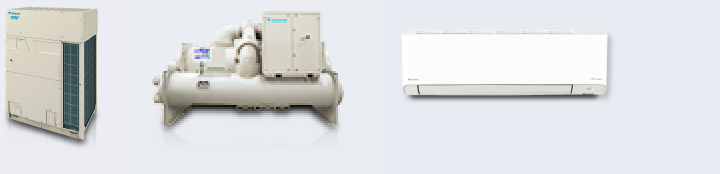
Irino: Daikin has developed a wide range of products in room air conditioners and VRV systems for commercial buildings. A VRV system is an individual-zone air-conditioning system for midsize buildings such as offices, with one outdoor unit serving multiple indoor units.
Applied air-conditioning systems, by contrast, condition large spaces such as airports, shopping malls, hospitals, and schools.
NEWS
Aiming for Global No. 1 in Applied Air Conditioning: How Daikin Co-Optimizes Motors and Inverters
FEATURE
2026.07.31
Building on its long experience in room air conditioners and VRV systems, Daikin Industries, Ltd. (Daikin) has been stepping up development of much larger applied air-conditioning systems in recent years—central systems used in large commercial and public facilities. Whatever the size of the equipment, one principle remains the same: the motor and inverter must be developed in close coordination and optimized as a pair to draw out the best possible performance. At larger capacities, however, the challenges become considerably more complex.
For this article, we spoke with Yusuke Irino, Senior Engineer, Kazutaka Mizota, and Akihiro Shiratsuki of Daikin's Technology and Innovation Center (TIC). The three engineers are developing motors and inverters for applied air-conditioning equipment. Their work highlights both Daikin's distinctive technologies and the team's determination to see development through to success.
Rising Cooling Demand and the Role of Applied Air Conditioning
There is a substantial difference in both capacity and equipment size: a VRV system has a maximum output of around 22 kW, whereas applied equipment is rated at 100 kW or more.
 Individual and central air conditioning
In recent years, the field has expanded to include data center cooling. Comparing market size in 2022 and 2024, demand grew sharply: 2.47-fold in North America and 1.51-fold in Europe. Against this backdrop, sales of applied air-conditioning equipment have grown to account for roughly one-quarter of Daikin's total sales.
Daikin is the global No. 1 company in the air-conditioning industry overall, but when the comparison is limited to applied equipment, other manufacturers have larger sales. As set out in the Strategic Management Plan FUSION 30 (*1), Daikin will accelerate development with the goal of becoming No. 1 in applied air conditioning as well.
――Addressing Climate Change While Managing Cost
Irino: At the same time, the environmental burden of data centers has become a concern in some regions, so we must also address climate change. Regulatory limits apply to the global warming potential (GWP) of refrigerants and the coefficient of performance (COP) of air-conditioning equipment, and our products must meet them. Because this involves trade-offs with cost, striking the right balance is essential.
Co-Optimizing Motors and Inverters for Large Compressors
――Critical Components That Shape Overall System Efficiency
Irino: Large screw and centrifugal compressors compress refrigerant through rotary motion. A screw compressor uses helical rotors, while a centrifugal compressor uses a high-speed impeller. The motor generates the required rotation, and the inverter controls the electrical power supplied to the motor. Together, they form a critical part of a chiller—a large refrigeration machine that circulates chilled water to cool an entire building—by converting incoming electrical energy into rotational energy. If this conversion is not highly efficient, the efficiency of the entire system suffers. TIC therefore positions air-conditioning technologies, including motors and inverters, as core technologies for Daikin's existing businesses.
In applied air-conditioning equipment, compressor performance has a major impact on overall efficiency because the system must deliver large cooling capacities reliably. The motor that drives the compressor and the inverter that precisely controls it therefore play a role comparable to the heart of the system.
High performance from each component alone is not enough. The way the inverter controls the motor changes the motor's efficiency, heat generation, vibration, and noise. Daikin therefore develops the motor and inverter as an integrated system and optimizes how they work together to create products with greater efficiency and reliability.
That optimization requires detailed tuning for the size of the equipment and how it will be used. Applied systems operate under conditions unlike those of room air conditioners, so development means solving, one by one, the challenges unique to large compressors.
 Overall configuration of a chiller for applied systems. The large compressor is a key component of the chiller
――Challenges Unique to Large Compressors
Irino: For example, if a small 1 kW motor is 97% efficient, the remaining 3% is released as loss in the form of heat. That amounts to only about 30 W, so cooling is not especially difficult.
With a 100 kW motor, however, even 97% efficiency means 3 kW of heat generation. That is comparable to the heat produced by several small electric heaters. As a continuous source of heat inside the motor, it cannot be ignored. Without appropriate cooling and heat-dissipation measures, temperatures rise in the windings, magnets, bearings, insulating materials, and other components, making it impossible to ensure safety and reliability.
If a 100 kW motor had 100 times the volume of a 1 kW motor, the heat generated per unit volume—its heat density—could be kept at the same level. In practice, however, we need both higher output and a compact design, so the product cannot simply become that much larger. As motor capacity rises, heat density and power density therefore tend to rise as well.
These challenges are difficult to solve by simply extending conventional technologies. We have to optimize not only the motor itself, but also the overall compressor structure, cooling method, and operating conditions. Close coordination with the compressor development team from an early stage is essential.

Mizota: As the equipment becomes larger, thermal and noise design becomes more difficult. With an unsuitable design, for example, electrical noise near the product can prevent a smartphone from functioning at all.
The power cables for a large inverter can also be about as thick as a tug-of-war rope. They are heavy and difficult to bend, so even positioning and connecting them takes considerable effort.
The Engineers Behind the Development

――Three People with Different Perspectives Working Together to Accelerate Development
Shiratsuki: I joined Daikin as a new graduate and am now in my third year with the company. (All references to years of service in this article are current as of July 2026.) At university, I researched magnetic-levitation motors, and I joined Daikin hoping to work on magnetic bearings and motor control.
A magnetic-levitation motor integrates the functions of a motor and magnetic bearings and is also known as a bearingless motor. Because magnetic force levitates the rotating shaft, there is no mechanical contact of the kind found in conventional bearings.
This minimizes loss and enables high efficiency even at high rotational speeds. I currently develop motor-control software, including microcontroller programs. Looking ahead, I personally hope to advance development toward the practical use of magnetic-levitation motors in applied air-conditioning systems.
Mizota: This is my fifth year at Daikin as a mid-career hire and my 11th year in the workforce. Before joining Daikin, I worked for a battery manufacturer, where I developed uninterruptible power supplies (UPSs). I had chosen to work on UPS development, but I wanted to develop larger equipment, which led me to Daikin. Since joining the company, I have developed hardware for large inverters for overseas markets and magnetic-bearing controllers. I am now working to improve inverter efficiency.
Irino: I also joined Daikin as a mid-career hire and am now in my 17th year with the company. I studied magnetic-levitation motors at university, but in my previous job I was an engineer at an automotive-parts manufacturer, where I was responsible for mechanical design. I decided to move to Daikin after becoming interested in motor and inverter control. After working on magnetic bearings and other technologies, I began leading electrical-system development in 2021. Today, I am responsible for motors and inverters for large chillers used in applied air-conditioning systems.
Developing an IPM-SM for High-Speed Centrifugal Compressors
――Applying One of Daikin's Core Strengths
Irino: Large applied air-conditioning products mainly use centrifugal compressors. Because a centrifugal compressor spins its impeller at high speed, the motor must operate at 15,000–20,000 rpm—two to three times the speed of a typical industrial motor. The rotor therefore needs high mechanical strength.
A motor often used for this kind of application is an SPM-SM, or surface-mounted permanent-magnet synchronous motor, in which permanent magnets are attached to the rotor surface. At higher rotational speeds, centrifugal force can cause the magnets to detach, so a protective sleeve is needed around them. Carbon-fiber-reinforced plastic (CFRP), titanium, and stainless steel can be used for the sleeve, but manufacturing difficulty and cost have been challenges.
To address these issues, Daikin adopted an IPM-SM—an interior permanent-magnet synchronous motor—for its centrifugal compressors. Applying an IPM-SM in a high-speed centrifugal compressor required us to combine the mechanical strength needed to withstand high-speed rotation with the necessary magnetic performance. Daikin launched the world's first residential air conditioner equipped with an IPM motor in 1996. By applying and building on the technology refined ever since, Daikin has achieved mass production for this application.
But developing the motor alone is not enough to draw out its full performance. The next critical step is to optimize inverter control around the motor's characteristics. By co-optimizing the motor and inverter as one system, we can raise both efficiency and stability to a higher level.
 In an IPM-SM, the permanent magnets (neodymium magnets) are embedded inside the rotor
Developing Inverters to Reduce Motor Heat
――The Future of Inverter Development at Higher Carrier Frequencies
Shiratsuki: Daikin has a long track record in inverter development for room air conditioners and VRV systems. For applied air-conditioning equipment, however, we are still in the stage of advancing full-scale development. We are using the knowledge built by our established development teams while tackling challenges specific to applied equipment.
Mizota: One of those challenges is the motor heat we discussed in connection with large compressors. Current fluctuations produced by inverter operation—known as carrier ripple current (*2)—are a major cause of motor heat. Increasing the carrier frequency, so that the inverter switches more finely, is an effective way to suppress that ripple. Daikin is therefore developing hardware equipped with power devices based on a new material, as well as software to improve efficiency. I am responsible for the hardware, and Shiratsuki handles the software.
 Inverter output current waveforms at low and high carrier frequencies
Shiratsuki: Reducing carrier ripple current helps lower motor heat, but it also increases losses in the inverter. Our goal is to improve inverter efficiency while reducing motor heat and ensuring compressor reliability. Achieving all three at once is the challenge at the heart of our development.
Mizota: If we can overcome these issues and achieve higher-carrier-frequency operation, it will open the way to new technology development in applied air conditioning—and ultimately to pursuing a world-first achievement.
A 1 MW-Class Test Facility for Large-Scale Product Development
――Testing Capacity Matched to Higher-Output Motors
Mizota: Chillers for data centers are becoming larger, which means they require motors and inverters with greater output. Larger products also require test equipment capable of handling them. To establish an environment for testing motors and inverters for large compressors, TIC installed a 1 MW (1,000 kW)-class test facility. Test facilities in Japan had previously topped out at around 400 kW, making this the largest-scale facility in the country. Until then, we had outsourced testing to overseas laboratories and suppliers. We can now finally carry out the entire process in-house.
Irino: Installing the facility was a major undertaking. The building did not have enough electrical capacity, so we had to use a crane to bring in large power-supply equipment and carry out extensive electrical work. Because the scale was unprecedented, every equipment manufacturer we consulted gave us the same answer: "We cannot build it." We ultimately procured separate pieces of equipment for each function, designed the overall system ourselves, and integrated the equipment. That was how we finally completed the 1 MW-class facility.

Why Applied Development Is Compelling for Electrical Engineers
――Trusted for Expertise, Regardless of Years of Experience
Shiratsuki: To keep meeting demand from AI data centers, it is essential to develop applied air-conditioning equipment that is highly efficient and has a lower environmental impact. I find it exciting that we can support some of the world's most advanced technological trends through air conditioning. There are still relatively few people specializing in motor control for applied systems, so even in my third year I am often asked to contribute my knowledge. That responsibility is very rewarding. I intend to keep working with the mindset that we are building the foundation for motor development in applied air conditioning.
Shiratsuki: To keep meeting demand from AI data centers, it is essential to develop applied air-conditioning equipment that is highly efficient and has a lower environmental impact. I find it exciting that we can support some of the world's most advanced technological trends through air conditioning. There are still relatively few people specializing in motor control for applied systems, so even in my third year I am often asked to contribute my knowledge. That responsibility is very rewarding. I intend to keep working with the mindset that we are building the foundation for motor development in applied air conditioning.
――Helping Address Global Energy Demand from Kansai
Mizota: I believe our work will make a real contribution to society. For example, a 1% improvement in efficiency can represent an amount of electricity equivalent to the consumption of several dozen households. Of course, we want to develop No. 1 technology, but beyond that, our goal is to contribute to the world's energy challenges. I like Kansai, so one of TIC's attractions for me is the opportunity to take on challenges with global impact while working here in the region.
――What I Gained from a Path That Once Seemed Indirect
Irino: Knowledge and experience in mechanics, not just electrical engineering, have helped me in unexpected situations. Around 2010, I worked on a prototype combining magnetic bearings and a high-speed motor. The technology was still at the basic-research stage, so I had to design the magnetic bearings, controller, software, and mechanical components all by myself. That is not unusual in research, but without knowledge across multiple fields, I might have given up. Going forward, I will draw on this breadth as the person responsible for motor and inverter development and continue advancing applied air-conditioning technologies so that Daikin can become No. 1 in this field.

(*1) Strategic Management Plan FUSION 30:
Daikin's medium- to long-term management plan toward 2030.
(*2) Carrier ripple current:
A current with a pulsating waveform generated when a drive circuit, such as an inverter, switches. It can cause not only motor heat, but also vibration and noise.

Yusuke Irino
Senior Engineer, Technology and Innovation Center
Joined Daikin in November 2009. From Kanagawa Prefecture.
Senior Engineer, Technology and Innovation Center
Joined Daikin in November 2009. From Kanagawa Prefecture.
Responsible for research and advanced development of magnetic bearings, as well as motor and inverter development for compressors used in applied systems. Aims to help Daikin become No. 1 in the Applied business through motor and inverter technologies.

Kazutaka Mizota
Technology and Innovation Center
Joined Daikin in January 2022. From Kyoto Prefecture.
Technology and Innovation Center
Joined Daikin in January 2022. From Kyoto Prefecture.
Responsible for R&D of high-capacity, high-efficiency inverters and next-generation magnetic-bearing controllers for compressors used in large-capacity centrifugal chillers. Takes on the challenge of transforming compressor performance through power electronics.

Akihiro Shiratsuki
Technology and Innovation Center
Joined Daikin in April 2024. From Shizuoka Prefecture.
Technology and Innovation Center
Joined Daikin in April 2024. From Shizuoka Prefecture.
Responsible for R&D and software development for motor control in centrifugal compressors. Aims to contribute to highly efficient air-conditioning systems through motors and control technologies.
*The content and profiles are current as of the time of the interview.
Related article
FEATURE

Daikin Undertakes Two Major Demonstrations at Toyota Woven City
2025.07.24
FEATURE

Achieving AC Energy Savings with AI: Automatic Energy Tuning Using Heat Load Predictions
2025.05.14
FEATURE

AC Solutions: Discerning the Latest Information from Daikin Case Studies
2023.10.30
