Manufacturing Transformation in the Digital Age: Developing AI Talent and Successful Graduates at DICT
Aiming to transform manufacturing in the digital age, Daikin Industries established the Daikin Information and Communications Technology College (DICT), a corporate university, in December 2017. In this article, we speak with Yoshihisa Toshima, Deputy General Manager for the Technology and Innovation Center (TIC), on the background in the establishment of DICT and HR development initiatives, and Tsuyoshi Isaka, a DICT graduate, on his experiences until now. We will also take a closer look at the tangible results that DICT has achieved in the six years since its establishment, the current state of DX being promoted by Daikin, and what lies ahead in the future.
Background and Purpose in Establishing DICT
——Acquiring practical skills equivalent to two years of graduate school
Toshima: As stated in our strategic management plan (FUSION), Daikin is taking on the "Challenge to Achieve Carbon Neutrality," "Promotion of Solutions Business Connected with Customers," "Creating Air Value," and transformation of the design and development and the supply chain processes. From that standpoint, data utilization is becoming more integral to business, and software technology is also becoming increasingly more important as a key technology.
Having operated as a traditional machinery manufacturer until now, Daikin suffers from a shortage of IT engineers within the company. What's more, only a few of them possess advanced IT skills such as data science and cloud computing. With little prospect of acquiring human resources from outside the company and having no IT personnel available within the subsidiaries, the Daikin top senior executive (currently, the Honorary Chairman) announced a policy to develop HR with digital technology skills unique to the company to address the need for acquiring talent. Consequently, DICT was launched in response to that in December 2017 as an in-house HR development system.
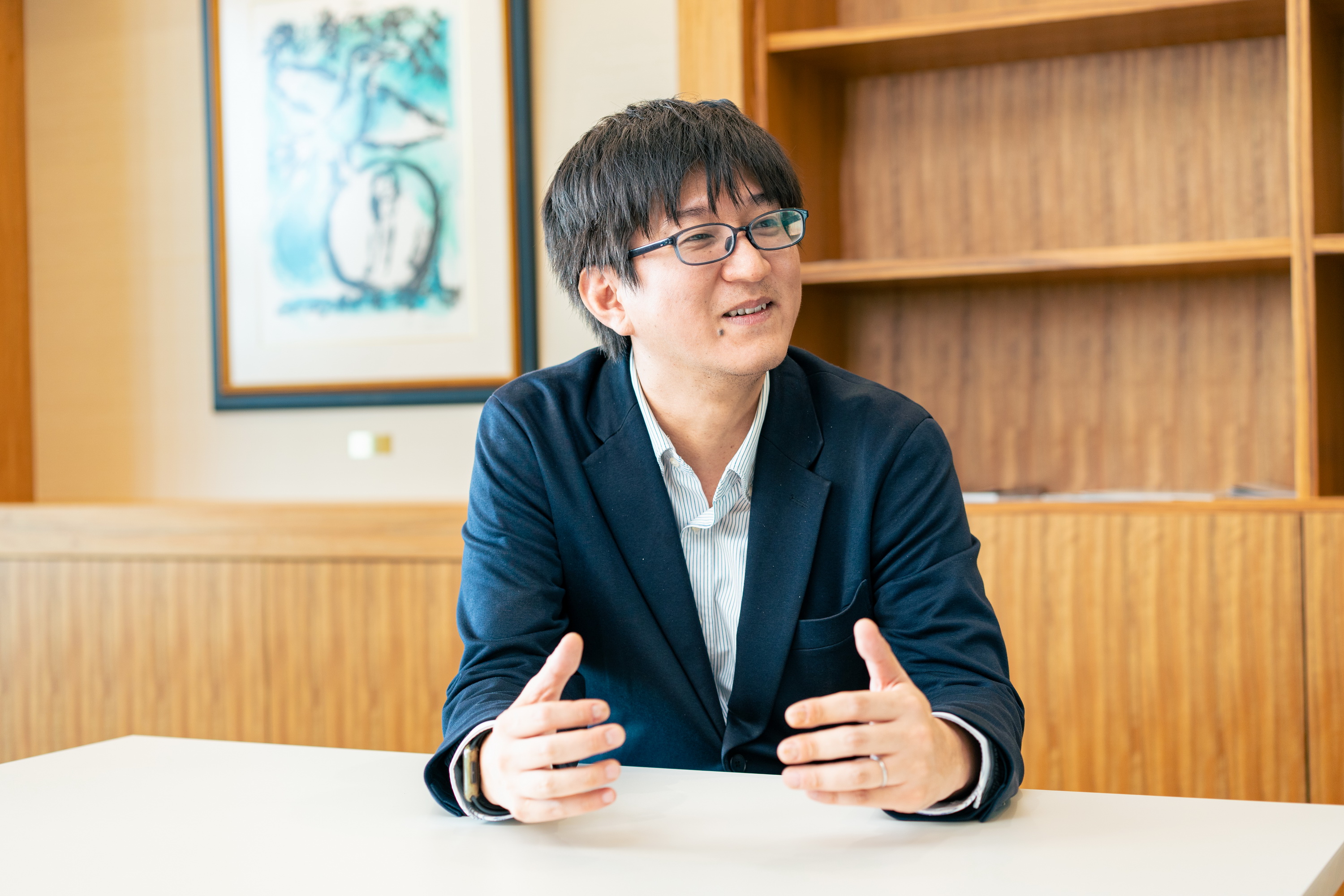
One distinctive feature of that training is that Daikin provides it not only to its current employees but also to 100 new employees every year. These employees receive two years of specialized training equivalent to the amount of training time that they would receive upon entering graduate school. The education itself is on an unprecedented scale and is planned and operated jointly by the Human Resources Division and the Technology and Innovation Center, the place where I am assigned.
Additionally, The University of Osaka agreed to cooperate with us as part of a comprehensive collaboration initiative, and their professors to help with planning, lecturing, and providing guidance on themes.And that is how DICT was established.
Characteristics of DICT's HR Development Program
——Three AI employee types needed for solving business issues
Toshima: In establishing the program, we had many discussions within the company about the requirements for human resources skilled in digital technology. In the process, specific requirements, such as the need for a basic understanding of AI and mathematical knowledge, soon became apparent. Based on these discussions, we concluded that the following capabilities were essential for the people who can solve real business problems:
(1) People who utilize AI
(2) People who solve problems with AI technologies
(3) People who understand and can generate AI algorithms
For example, the second type refers to human resources who, like Isaka, understand the essence of AI algorithms and can devise ways to use them to solve problems. The third type is a specialist who can systematize AI technology, such as creating a mechanism for collecting and storing data gained from air conditioners, making proposals to customers, and implementing a control system.
——Specializing curriculum according to job type and role
Toshima: Educational curriculum is planned and implemented according to the personal profile and skill level and is developed every year by revising or abolishing previous curriculum and adding new curriculum. For example, the "AI who utilize HR" curriculum is a program in which existing business department members who are currently working on their jobs take AI lectures and use the skills that they acquire to solve business issues in their own departments and positions. "AI technology development HR" is a type of HR who have never previously existed, and the content is like training new employees from square one.
"System Development HR" provides education on the latest cloud and AI technologies along with systematic system development processes to engineers in existing departments who work in software development such as product software, IoT systems, business systems, and in-house IT infrastructure. New employees who join the company as new graduates also study this curriculum.
 HR development in three areas: AI business use, problem solving, and actualization
DICT Achievements: "IT Japan Award 2024" Special Prize
——Keys to winning the IT Japan Award: Unique HR development and cutting-edge AI implementation
Toshima: Seven years have passed since the establishment Daikin Information and Communications Technology College (DICT) and just as the number of people handling the latest technologies, such as AI and cloud computing, has spread to each workplace, we receive news that we had won the "IT Japan Award 2024" sponsored by Nikkei Computer. This was based on a recommendation from the organizers, who provided the following commentary for the award:
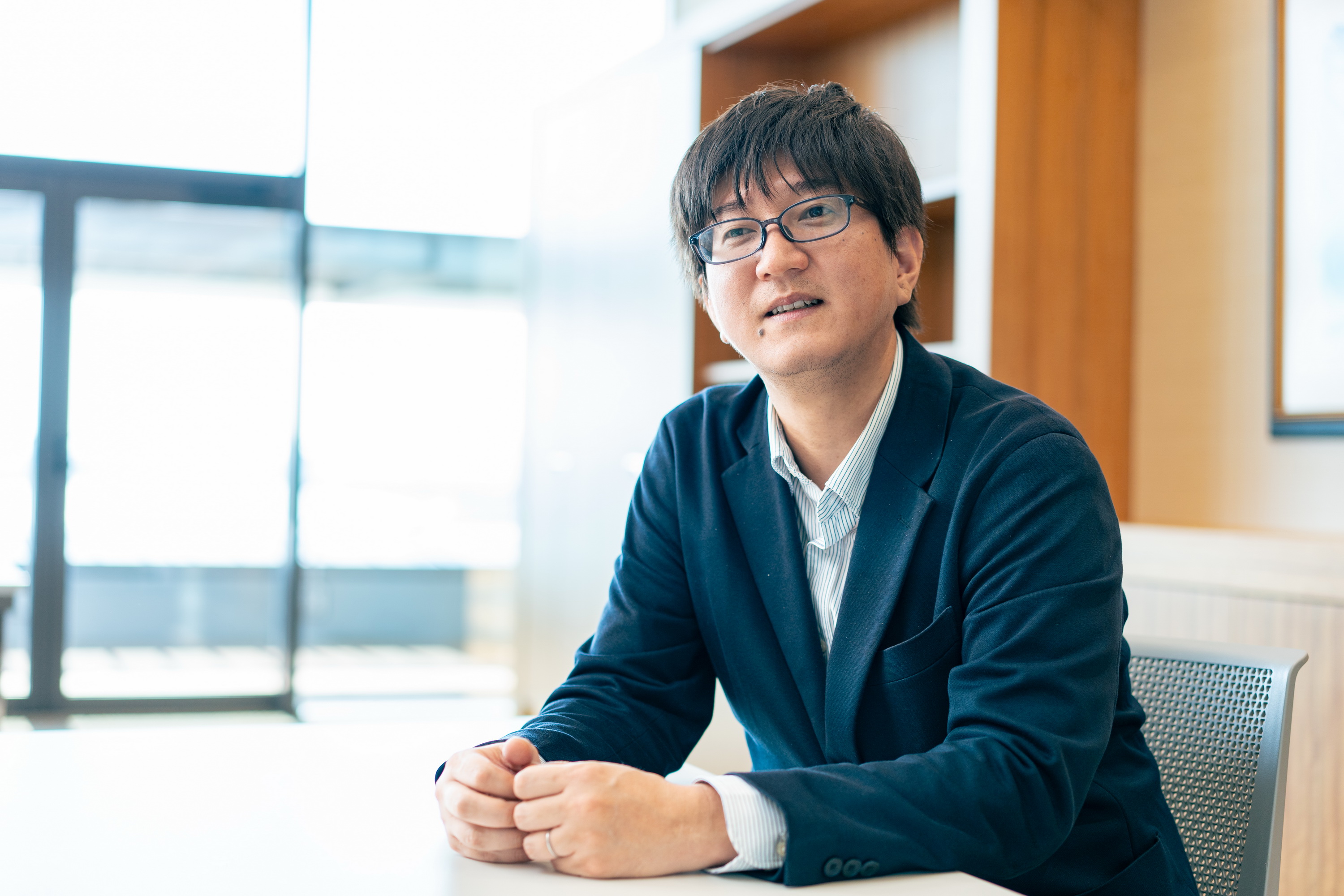
"The distinctive feature of Daikin's HR development is that it has taken IT education in-house within its business companies. It also pursues initiatives that are unique to the company."
"When the generative AI boom arrived, Daikin was one of the first to launch a ChatGPT-based chatbot."
We were also the first among Japanese manufacturing companies to conclude an agreement with OpenAI for ChatGPT Enterprise. Unsurprisingly, we had never before received an award from the IT industry like the IT Japan Award, so it gave our in-house IT members a huge boost of confidence, while also providing a greatly appreciated PR opportunity outside the company.
Activities of DICT Graduates
——Encountering Daikin as a global leader and discovering the ideal research theme in the specialty of IAQ
Isaka:Before joining Daikin, I did research into deep learning hardware at The University of Osaka and used a variety of analytical methods to conduct research and development.My decision to join Daikin comes from the research I did overseas at the National University of Singapore as a graduate student. During my time abroad, I saw for myself Daikin as a global air conditioner manufacturer with a diverse product lineup, and it was then that I developed a strong interest in the company. That experience abroad become the deciding factor for me in choosing Daikin as the company where I wanted to work.
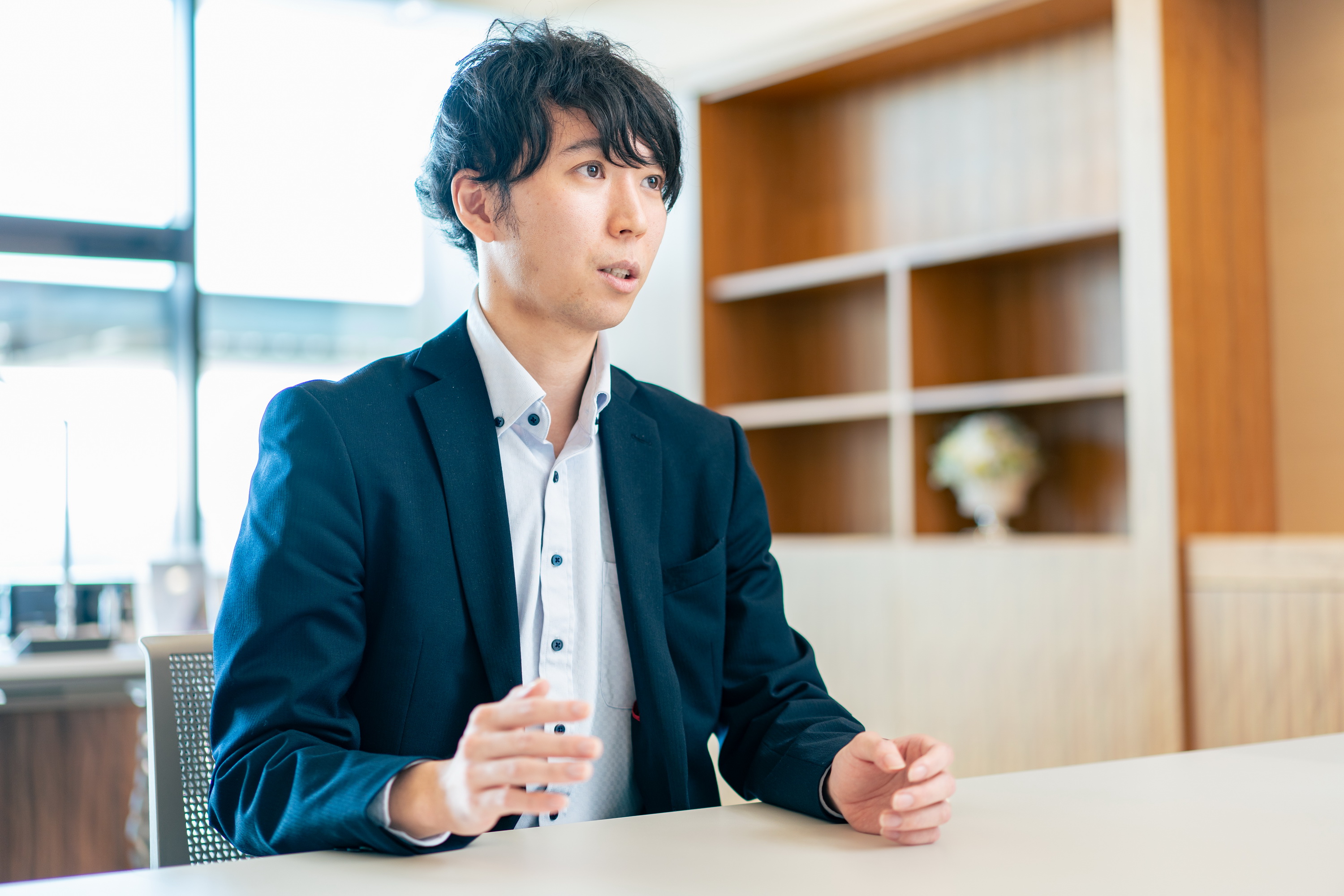
Isaka: Currently, I am involved training development for IAQ at Daikin. IAQ is the English abbreviation for indoor air quality. I'm a member of a group that has gathered together air quality experts.My work involves predicting temperature and airflow distribution in indoor spaces based on data measured using ultrasound. Since joining the company, I had always wanted to contribute by merging IAQ and AI, so I find my current work extremely rewarding.
——A fulfilling research environment
Isaka: In my university days, I had studied deep learning, but the training at DICT enabled me to learn AI in a systematic way, including other aspects such as machine learning. Also, the scale of the computers available is so much higher than that of my university, and I was impressed by the scale of technological investment that is unique to large companies.Not only that but being able to build relationships with senior engineers, young engineers, and other types of colleagues through the DICT training has become such a great asset for me.
——Work environment supports learning and growth
Isaka: It is a work environment where you can do whatever you want. In particular, the group that I belong to has many IAQ specialists, but when I look across the company, there are also many IT specialists. Taking advantage of the in-house study groups and other communities, I have learned many things, including technical calculation methods. I've also had many opportunities to talk with my bosses. They have created an environment in which I can feel comfortable telling them what I am interested in and what I want to do. Through these discussions, they try to understand what I'm thinking and offer various types of support. In turn, I often make suggestions of my own.
——Challenging Kaggle begins from conversations with colleagues
Isaka: Kaggle is a global online platform where over 20 million data scientists and AI engineers participate to improve their skills. I initially thought of Kaggle as an online data science course, and that's why I joined. I had heard it was an opportunity to learn about AI and new technologies. I joined Kaggle during my first year of working at Daikin. Some of my colleagues were interested in it, so I thought that would be fun and joined.
——LLM competition success leads to Kaggle Master award
Isaka: Kaggle has an activity called the "LLM Competition" that uses generative AI like ChatGPT. The LLM Competition is a competition (game) in which participants compete to solve specific tasks, mainly using a large-scale language model (LLM) as subject matter.I participated in a competition called LLM 20 Questions and placed ninth out of 832 teams. For that, I received a gold medal, which together with the two medals that I had received in the past, led to me winning the Kaggle Master award.
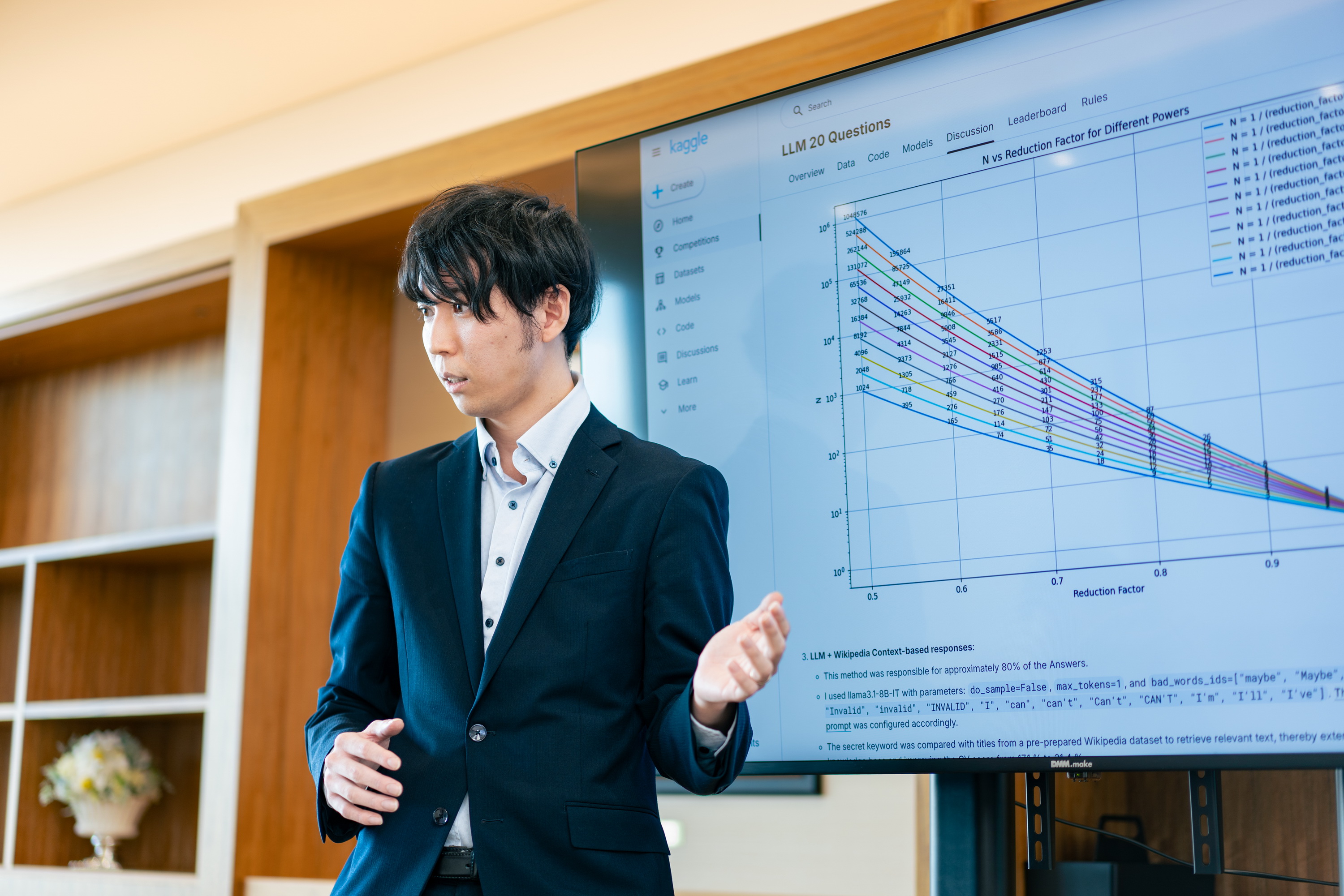
To progress through "LLM 20 Questions," a "secret keyword" is set at the beginning. Then, to find the "secret keyword," "questions and answers" are repeated several times. Based on the questions and answers, the generative AI then guesses the secret keyword.What's hard about this LLM competition is that even if you were able to obtain good prediction results in a preliminary evaluation using the generative AI that you had created, the prediction performance could sometimes deteriorate in the actual evaluation. In technical terms, this phenomenon is referred to as "low generalization ability (※1)." Thus, the most difficult part was going through various tuning processes to create an AI with high generalization capabilities.
Note (※1) What is generalization ability?
Generative AI has excellent inference performance for specific information (dataset), but may not perform correctly for other data sets. Generalization ability is defined as the ability to derive correct inference results (inferences that are stable) for any data set.
DICT Renders Its Vision for the Future
——DICT's mission: Developing IT HR and applying technologies at the frontlines
Toshima: At the end of fiscal year 2023, DICT had achieved its plan of training 1,500 people. From that, we plan to train 2,000 people by the end of fiscal year 2025. Graduates are currently working in various departments, including business planning departments and TIC. However, rather than DICT training ending in two years, we plan to promote efforts to improve the quality of the educational curriculum to ensure that graduates will continue to grow into core human resources in the future. Furthermore, DICT's efforts uniting education and practical application are currently centered in Japan, but we would like to expand our activities overseas.
——Being a company that leads the industry in IT technology
Toshima: As seen by our recent IT related awards (such as the IT Japan Award), our IT HR development training is beginning to receive recognition from other companies. However, I don't think that our presence in the IT industry is sufficient. My goal in the future is to achieve groundbreaking results and establish the company's brand image as "an industry leader in the use of IT technology."
——Using AI for a better life and environment
Isaka: There are many things I want to achieve at Daikin. For example, by merging IAQ and AI, I hope to leverage knowledge from large-scale language models (LLMs) to create innovative AI solutions that improve people's lives and the environment.
Messages to IT Engineers
——A stage for innovation for people who take on new challenges
Toshima: Daikin is a company that continues to grow and take on innovative challenges. Applying digital technology has become one of the most important strategies for the company's further development in the future. In our company, each employee is provided with opportunities to take on challenges in a variety of fields. To ensure that these challenges lead to substantial results, we have established a comprehensive support system, including a comprehensive educational program, an active technical community, and a detailed follow-up system. We always look forward to connecting with like-minded people who have a strong desire to achieve self-realization and who can grow together with us.
——Supporting growth and challenges is the Daikin corporate culture
Isaka: At Daikin, there are diverse learning communities that actively support the growth of each employee. Deputy General Manager Toshima and other executives are also involved and support the growth of employees. The fusion of air conditioning technology and AI holds infinite possibilities for creating new value in our lives. We look forward to receiving applications from individuals who are willing to join us in the unknown field of "creating value with air."
※The information and profiles are based on the time of the interview.
Yoshihisa Toshima
Deputy General Manager (IoT/AI), Technology and Innovation Center
Joined in April 2007. Originally from Kanagawa Prefecture.
Responsible for IoT/AI-related technologies, data utilization promotion, and digital talent development.
"I want to help us evolve into a cutting-edge company in the digital field while continuing to take on new challenges, learn even more than I know now, and contribute to the development of society and industry."
Tsuyoshi Isaka
Technology and Innovation Center
Joined in April 2020. Originally from Osaka Prefecture. Responsible for AI development using data related to air.
"As an AI and data analysis specialist, I want to develop innovative AI that will improve the air environments for everyone."
Related article