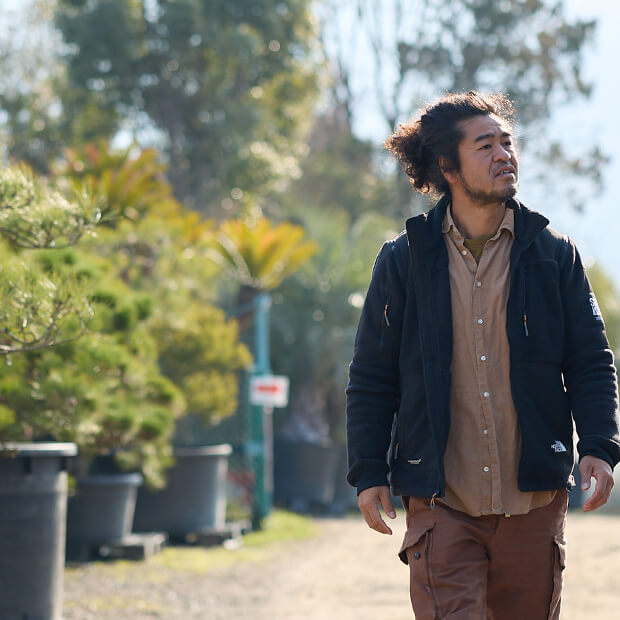





Yohei Sugiyama is an artist who blends the different art materials of dye and acrylic gouache to capture the essence of a motif. This approach coincides with his dynamic style of observing seemingly contradictory elements from various perspectives. This made us wonder how he perceives space when confronted with architecture and nature and what he hopes to convey. Under the theme of “Harmony of Contradictions,” we delve into the creative world of Sugiyama as he describes how he gives form to the unseen essence of things.
Beauty in the harmony of contradictions
Currently, I create my artwork using two art materials: a dye called “Suncolor” and acrylic gouache. I started this style of painting in university when a professor in the Crafts Department suggested an easy-to-use dye while I was working on a kimono as part of a graduation project. “Suncolor” easily permeates fabric fibers, generating a delicate blurring of colors. Acrylic gouache, on the other hand, lends itself to hard, edgy expressions. I discovered that intermixing art materials with contradictory properties can lead to both materials having a positive effect on each other.

This technique also complements the way in which I approach a motif. I believe that everything has a front and a back and that they exist as one entity. The essence of the motif lies in their harmony when these two elements are seen without bias. Whether it be both graphic and surreal, inorganic yet organic, or traditional but also innovative, I find beauty in their juxtaposition. In my work, I have sought expression for the world of contradictions.
Words used to invoke serendipity
When I tackle a subject to paint, I first completely empty my mind and view it from a perspective of zero emotion. From there, I observe various things and put those observations into words. It’s as if I’m looking at the various aspects logically but am expressing them instinctively. For example, if we’re talking about Izumo Taisha Shrine, many keywords come to mind like “rope” and “diagonal.”

Once that’s done, I start sketching by hand. As I keep sketching, there comes a time when I suddenly have a moment and I think, “Ah, this is it.” And so, I keep drawing, letting my hand tell me what to do until I capture that feeling. If I allow myself to merely trace an image in my head, then the result inevitably leads to something boring, so I keep moving my hand in pursuit of serendipity, something far beyond my imagination. This can be a very painful process.
Capturing the essence of architecture
Until now, I have often painted plants and other things, but last year, after creating a poster celebrating the Japanese architectural unit SANAA winning the Charlotte Perriand Award, an award given to international architects and designers, I began to use architecture as a motif.
At Izumo Taisha, the relationship between the shimenawa (a sacred shrine rope) and the Kaguraden grand hall intrigued me. The enormous rope, while part of the building, also retains a mysterious presence as if it is floating in the air. Although it’s an accessory, it's also the centerpiece that wouldn't exist without the shrine building. I felt its essential beauty from the mutual relationship between the two in which one seemed to support the other while also being supported.

Title: "Izumo Taisha Shrine"
In painting the Tokyo Station building, I struggled to capture its essence. With Art Deco curves, linear decorations, and Japanese elements, its intricate design overwhelms you with information, far more information than with plants, and that alone forced me to strip it down as much as possible to understand what I wanted to do. Surprisingly enough, the final work turned out to be completely different from the initial sketch and was the result of having to wrestle with it for nearly a month.

Title: "Tokyo station"
What I arrived at was a continuity where elegance and industrial straight lines intersect. The train station must have been an extremely innovative design when it was built (in 1914) during the early Taisho period, but its fusion of Western and Japanese architecture gives it a timeless beauty that never goes out of style.
However, even after deciding what I wanted to convey, bringing them all together into a tangible form proved to be a difficult task. I couldn't overstate the linear elements, nor could I rely too much on the elegance of the curves. I tried sketching it over and over until I found what I wanted to portray.
Repeating questions like a Zen dialogue

Title: “Leaf peony”
When depicting plants and nature, I also remain committed to discovering their essence. Because plants provide less information than buildings, I sometimes bring back once-discarded elements.
Or, when drawing a snowy landscape, I may find that the ambiguity in the shape of snow makes it difficult to draw. However, if you think of its shape as it relates to something—for example, the relationship between snow and pine trees—then you can gain a sense of the stillness and warmth in the way the snow piles up. To capture its essence, I repeatedly ask myself, “What is the essence of snow?”, and like the dialogue of a Zen Buddhist priest, there is no definitive answer.
Nevertheless, while it may be hard work, I consciously try to take on new themes. Even though the essence may be the same, the resulting form may be completely different depending on the theme. Continuing to paint new things keeps my work fresh and interesting while also leading me to more discoveries and new shapes.
Spatial harmony and dissonance
To me, “contradictions” are an eternal theme and something that has always fascinated me. This is why I want art to also have contradicting qualities. My own artwork neither blends into space nor does it dominate it. It harmonizes with space while maintaining a sense of dissonance. In this way, I hope that my artwork can be both the main and supporting actor.

Even in interior design, rather than having overly homogenized spaces, I prefer spaces that incorporate dissimilar elements. For example, pairing the mid-century furniture of Eames with the modern furniture made from material scraps of Piet Hein Eek is a way in which different eras and materials can strangely exist in harmony in one space, and that appeals to me. That’s probably why I like to paint things myself.
In the future, I would like to try painting traditional scenes such as a “Oimatsu” (old pine tree) in a Noh theater, a Kabuki stage, or a temple lecture hall. In those spaces, a graphically rendered work would come across as trivial, but rather than just using traditional methods, I like seeing new forms of expression being explored. I believe that if you can see a world that's neither ridiculously contrived nor just the same as before, you can find a comfortable space within it.