



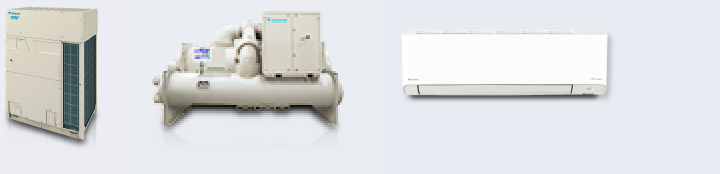

Nishimura: Applied air-conditioning systems are large-scale systems used in a wide range of commercial and industrial facilities, from hospitals and schools to factories. The systems use a chiller to produce cold or hot water, which is transferred to the air handling unit and other air-side equipment to deliver cold or hot air.
In the data center market, the requirements for applied air conditioning include system customization for each customer and rapid delivery and deployment. Hyperscalers (large-scale cloud computing companies) possess proprietary know-how on data center design. Daikin must guarantee optimal cooling capacity for each company based on their specific requirements. The AI market is evolving at an intense pace, and in this market landscape, the delivery timelines continue to shrink.
NEWS
Cooling technologies ensure high-performance data center operations.
Daikin Industries (Daikin) reorganized its global applied development operations to address the urgent challenge of developing these technologies. Today, Daikin is developing large-scale compressors and other applied air-conditioning equipment to meet the recent surge in global demand for data centers.
This article shares the development story behind core data center cooling technologies, featuring team members Mr. Shota Harada and Mr. Tatsuki Inoue from Daikin Technology and Innovation Center (TIC) and Ms. Tomoka Nishimura from the Applied Solution Business Division.
A New Wave of Demand for Applied Air-Conditioning Systems and Special Requirements for Data Centers
Nishimura: The general air-conditioning market in advanced nations has matured, and until very recently, there have not been any large spikes in demand. In recent years, however, the market has changed. Between 2022 and 2024, the size of the chiller systems market has grown 2.5 times in North America and 1.5 times in Europe. The driver of this demand surge is data center construction, primarily in North America. With the popularization of interactive generative AI services since 2022, generative AI has gradually expanded to every area of our daily lives, and today it is an essential part of the social infrastructure. Demand is growing for data centers required for the provision of generative AI. Amid this trend, applied air-conditioning systems have become increasingly important. The role of air conditioning has changed from simply providing comfortable environments for people to the more stringent requirement of continually cooling the heat generated in data centers.
――From Large-Scale Facilities and Factories to Data Centers
――From Space Cooling to Rack and Chip Cooling
Harada: The applied systems used for cooling server rooms are similar to conventional systems in that they cool the entire room. The server rooms house a multitude of server racks which generate heat. Temperatures must be managed to prevent hot spots where heat accumulates (high temperatures in specific areas). One of the significant changes in the use environments is high heat generation per unit of space. Daikin is now providing comprehensive cooling solutions that encompass not only spaces, but also server rack and chip cooling.

Daikin’s Centrifugal Compressor Development
Harada: Screw compressors and centrifugal compressors are critical components in applied air-conditioning systems. TIC develops these technologies for Daikin. We are developing centrifugal compressors with higher cooling capacity compared with conventional models. The centrifugal compressor compresses a fluid by turning the impeller, which looks like the blades of an electric fan. For the rotating parts of the compressor, Daikin pioneered the use of magnetic bearings—one of our competitive advantages.


――Contactless Magnetic Bearings Turn a Heavy Shaft
Inoue: Bearings are used to support a turning shaft, and in conventional machines, the bearings are mechanical balls called “ball bearings.” Magnetic bearings use magnetic force to make the shaft levitate. In a large-scale compressor, a shaft with an overall length of a meter or more will levitate only 0.1–0.2 mm. This contactless design ensures ultra-smooth turning. The entire turning parts of the compressor weigh approximately 120 kg. Controlling the vibration of such heavy machinery to a precision of 200 μm (0.2 mm) or less is a tremendous challenge. My area of expertise is software design. Software alone, however, cannot control the magnetic bearings to that level of precision. We coordinate efforts among the engineers in charge of machinery, electric power, heat management, and other areas to develop the systems for rotation of the centrifugal compressor.

――Ceaseless Efforts for Improvement
Harada: Daikin’s advantage is our internal manufacturing of the core parts of the compressor. The rotation of the impeller compresses the fluid. However, vortex whirl causes energy loss and lowers efficiency. One of the most important tasks in this project is the development of a highly efficient power-saving impeller.
A motor with high power-efficiency is also necessary. A further challenge is the difficulty in procuring rare earth metals. Conventional motors use rare earths, whose prices have skyrocketed in recent years. We are therefore striving to limit the amount of rare earths used in the motor. Our mission is to seek improvements in every one of the core components of the centrifugal compressor through ongoing development efforts.
Aiming for TIC’s First Magnetic Bearing Centrifugal Compressor Fully Produced In-House
Harada: The third generation of Daikin’s magnetic bearing centrifugal compressor debuted in 2024. Currently, we are developing the fourth generation. The history of the product reflects Daikin’s goal of internally producing its technology. In the first generation, development of the motor and the magnetic bearings was outsourced. In the second generation, we developed the magnetic bearings in-house, and then in the third generation, we succeeded in developing our own motor. We have outsourced impeller development for all previous generations, but for the fourth generation we are developing the impeller internally (as of June 2026). Cost was an issue with the third-generation system, and we are striving to lower the production cost further.
Generally, applied air-conditioning systems require a chilled water temperature around 7℃. State-of-the-art data centers, however, require water temperatures of 20℃ or higher, and the standard temperature is likely to continue rising. Unlike those designed for work or living spaces, the dew point temperature is not a particular concern with air-conditioning systems for data centers. Data centers are designed to minimize PUE (*1) using cold external air, so-called free cooling, and other methods. Although the difference between the temperature requirements for conventional applied systems and data centers is only 13℃, this difference requires a significant change in the centrifugal compressor design. Additionally, the fourth generation system uses three different impeller designs to ensure that we can adjust operations to meet the specific needs of customers in terms of chilled water temperature, pressure, and other specifications.
――Smoother Path to Total Optimization and Clearer Responsibilities
Inoue: The reorganization of the applied systems group put Japan in charge of product development. The result is that we have made strong progress with experimentation, and comparison with simulations has become easier. Our goal was the total optimization of the system—not the optimization of individual components. We have used prototypes to rapidly generate experimentation results and enhance the development process, achieving the kind of total technology optimization that the Japan side excels at. The applied air-conditioning systems business requires a broad lineup of models. When we create smoother work processes, it accelerates the pace of systems development.

Harada: Consolidating responsibility for systems development in Japan was a positive change. In the past, we distributed the development responsibility among departments around the world, and among different Group companies. Each of these organizations used buffers to hedge risk, but this increased costs. In the new structure, we can oversee the entire development from Japan and control risks centrally, which leads to better decision-making.
Backgrounds of Three Members from TIC and the Global Applied Development Group
Harada: I joined Daikin in 2022 after working for 10 years at a heavy machinery manufacturer, where I designed impellers and other components for jet engines. My first assignment after entering the company was to improve the efficiency of the centrifugal compressor. After I was appointed project leader in 2024, and I became the manager for integrating various elemental technologies used in centrifugal compressors and for overall project promotion.
The development structure for applied air-conditioning systems changed radically in 2025, when the development leadership was reassigned from the United States to Japan. Under the new organization, TIC is in charge of large compressor development and leads compressor development for all units worldwide. Centrifugal compressors are comprised of many different elemental technologies. A change in one of these technologies can have a large impact on the entire system. For that reason, the product development process must provide oversight of the entire project and progress from the viewpoint of ensuring total optimization.
――From Inverters to Magnetic Bearings Development
Inoue: I joined Daikin in 2015 right out of university. My first assignment was the development of inverters for building-use air-conditioning systems, which I spent four years on before joining the newly formed Applied Group. From around 2021, when we initiated development of the third generation compressor, I took charge of magnetic bearings for large-scale compressors. Since we have just undergone a major reorganization, there are still areas for flexibility in applied development. That’s why I feel it is important to build communication with colleagues working on other technologies and strive towards successful compressor development as a team.
――Leveraging Experience Outside Japan to Support TIC
Nishimura: I also joined Daikin out of university in 2015. I was assigned to the Applied Solution Business Division and supported business promotion efforts, including applied products strategies for China, the United States, and Europe. After that initial assignment, I transferred for a year to Daikin Applied Americas (DAA), where I worked on the development of rooftop air-conditioning systems. In 2025, I joined the Global Applied Development Group, which was newly formed to bolster applied development. Currently, I’m in charge of planning air-cooled centrifugal chiller products, helping coordinate efforts among global units in support of the central development structure in Japan.
The Global Applied Development Group was formed inside the Applied Solution Business Division as a development-driven organization. It approaches development from two perspectives: solving engineering issues from a technical perspective, and promoting business from a management perspective. Historically, Daikin’s applied development business outside Japan began with the acquisition of OYL, the parent company of McQuay International. There’s still plenty of room for additional synergies with these businesses in the future.
The Fulfillment of Working in a Global Development Structure Based in Japan and at TIC
Harada: TIC developed the main concept for the fourth-generation magnetic bearing centrifugal compressor. The Global Applied Development Group, meanwhile, is in charge of the overall product system, including the heat exchanger and the pipework. We are integrating all of these technologies into a base model which the global sites can optimize to meet local specifications and requirements, and then develop their markets. This concurrent development approach enables TIC, the Global Applied Development Group, and local sites to work on systems development and design in parallel.
Nishimura: Applied development typically takes 2–3 years to complete. The data center market, however, is moving at a much faster development cycle. The specifications and capacities we are building into the systems may have to change in the middle of systems development. We need to maintain close communication with all the sites to respond to this kind of change. One of the roles of the Global Applied Development Group is to smoothly coordinate information exchanges with TIC.
――The Satisfaction of Balancing Freedom and Responsibility
Harada: Daikin values people who proactively take the initiative and suggest work assignments themselves, and TIC is of course the same in that respect. Staff have the freedom to make proposals on their chosen assignments, and once they receive approval, they can set their own course in developing technologies. We have a deeply rooted culture of respecting the ideas of younger staff, and this creates an atmosphere where everyone can freely exchange opinions. Of course, there are many struggles at the workplace. But we have a culture in which each of the project team members can take ownership over their work with an earnest heart, and at the end of the process, take great pride in saying, “This is my development.”
Inoue: The greatest pleasure for me in working in applied development is the sheer scale of the work. We are developing and building large-scale machinery designed for data centers at the cutting-edge of today’s technology. And once completed, we can actually witness the systems in successful operation. There is a tremendous sense of fulfillment in working in an environment where we can freely exchange our views, back up our words with action, and see our work through to its end. This is what makes working in applied development so interesting.
Harada: It’s as difficult as it is interesting. We must see the development through to success, and then we must also be aware of the importance of developing the applied business as a whole. We are still in the middle of developing Daikin’s centrifugal compressor. We are blazing a new path where no road exists. Our only goal for the applied business is to be No. 1 globally. To achieve that, each of our team members must be No. 1 in their skill areas. Development never progresses the way we want it to, and there are always hurdles in our way. That’s the truth. The only way to succeed is to struggle through it and overcome the hurdles.
Future Development and Message to Engineers Interested in Working for Daikin

Nishimura: Applied air-conditioning systems are not simply air-conditioning equipment, but represent critical social infrastructure supporting cultural and economic activities. Daikin is aiming to be No. 1 in this market, and we want teammates full of the spirit of challenge.
Inoue: Data centers are a hot industry today. It’s essential for Daikin to be there when history is being made for air-conditioning systems manufacturers. We have made organizational reforms to meet the needs of this new era, and there’s a feeling that we are blazing a new trail here. We want to work with people who can think for themselves and offer new ideas, people we can count on to work together, as a team, to overcome all obstacles to success.
Harada: We want ambitious go-getters. It’s a hot market where these types can succeed. I don’t think there have been many markets where people have this kind of opportunity to make a difference for society. That’s the kind of exciting development atmosphere we are working in each day. This kind of work demands ambitious people who do everything possible to get great results. Those are the types who do well at Daikin. I look forward to working with any new colleague who has that desperate desire for success and won’t settle for failure.
*1) Power usage effectiveness (PUE) is the ratio of power used by a data center’s IT-related equipment versus the total power consumed by a data center. The closer the measure is to 1.0, the higher the power efficiency of the data center.

Technology and Innovation Center
Joined Daikin in April 2022. Born in Nagasaki Prefecture.
Manager of centrifugal compressor integrated design and project promotion. Dedicated to development of a proprietary Daikin centrifugal compressor helping to solve the challenges of customers and society.

Technology and Innovation Center
Joined Daikin in April 2015. Born in Hyogo Prefecture.
In charge of development of magnetic bearings for centrifugal compressors, utilizing control and electric circuit technologies. Dedicated to the development of highly efficient, highly reliable air-conditioning systems driven by technological leaps in magnetic bearings.

Applied Solution Business Division
Joined Daikin in April 2015. Born in Kanagawa Prefecture.
In charge of global product planning for applied systems, including air-cooled centrifugal compressors for data centers. Dedicated to delivering new value by leveraging Daikin technologies for applied products.


