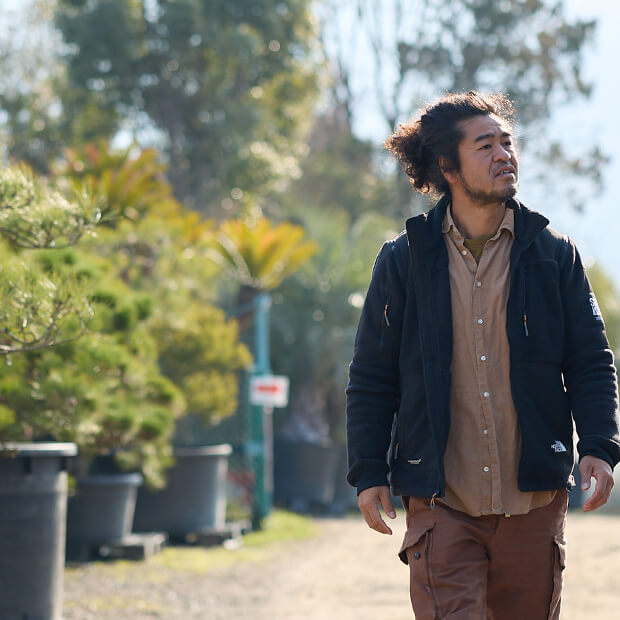




Contemporary design studio we+ has attracted attention both in Japan and internationally for works shaping new perspectives and values on urban and natural environments. Each project takes a distinctly different form, born of rigorous research and experimentation to uncover unexpected phenomena and new possibilities for expression. To learn more about this approach, Masahiko Choji, Group Leader of Advanced Design at Daikin Industries, visited the we+ studio to speak with founders Toshiya Hayashi and Hokuto Ando about their philosophy of monozukuri—the art of making things.
The Innate Pleasure of Creating Things
Choji: I'm delighted to meet you both today. I had a chance to tour your office earlier, and it felt very fresh and inspiring. People were actively making things in an atmosphere that seemed more like a laboratory.
Ando: Our basic approach has always been to create things by working directly with our hands. Naturally, we also pursue conceptual ideas through research, organize and interpret the contexts surrounding them, and take a broader view through cultural and historical perspectives. But studying materials—thinking through your hands—is just as important. Unless you physically experiment and engage with materials, you are unlikely to encounter new aspects of them or discover phenomena you've never seen before.
Another important aspect is thinking with your feet. For us, that means visiting factories and seeing firsthand how things are made. That kind of knowledge cannot be found online, nor is it something that AI can fully provide. Talking to people on site and experiencing a place through all five senses—including its sounds and smells—is incredibly important. There is a limit to what can be created from existing knowledge and inspiration alone.

Hayashi: I think my generation understands that feeling intuitively. Growing up in Toyama Prefecture, I was raised in a family that operated a farm part-time. My father and grandfather worked in agriculture and would even adapt their tools to the job. My grandmother knitted and sewed. Back then, it seemed everyone possessed some sort of practical skill.
By contrast, today, almost anything can be easily ordered online. Even toys for our children can be purchased as ready-made products. And yet, I think the ability to shape our surroundings by crafting things ourselves is a fundamental part of human joy—something that connects us to our humanity. Visiting a worksite or creating something with my own hands makes me deeply appreciate being alive.
What was once taken for granted is now something we have to seek out consciously. I believe this awareness is important not only for designers, but for all of us.
Choji: As convenient tools like AI continue to advance, the pressure to prioritize efficiency is only increasing. Even so, I completely agree with what you're saying. For designers and others seeking to create new value, thinking with your hands and feet is essential.

Listen, Understand, Then Offer Your Own Perspective
Choji: One thing I've noticed about we+ is how frequently you collaborate with other companies. In working with clients, particularly with B2B companies, you often encounter technologies that can be difficult for the general public to understand. How do you approach interpreting and communicating them through your own creative lens?
Hayashi: For example, when collaborating with a company that manufactures analytical instruments, we created an installation that communicated the technology intuitively rather than explaining it purely in scientific terms. Throughout the process, both parties considered how the story should be told, while exploring what form of expression would be most compelling. We constantly moved back and forth between conceptual thinking and hands-on creation as the project evolved.
Ando: In commissioned work, the first priority is to thoroughly understand the client. We spend three to five months conducting intensive research—learning about the company's activities, studying its history, tracing the evolution of its products, and listening intently to what the people who work there have to say.
I think of this process as putting down roots. Only deep roots can support a tall tree. Without them, even something that appears solid can topple at the first gust of strong wind. Once that foundation is in place, there comes a stage where we distill everything into an abstract concept and ultimately translate it into a final expression.
Hayashi: The stories told by people within companies are always fascinating and emanate from jobs and worlds that we would never otherwise encounter. We ask them directly what they care about and what they value most. When we do, we often hear things that are more human and personal than official mission statements or corporate philosophies. For designers, the challenge is to recognize those unspoken themes—to notice what hasn't yet been put into words and bring it to the surface.

Choji: From a client's perspective, it must be incredibly rewarding when someone is able to put a finger on what makes their company unique. It also makes any resulting proposal feel far more convincing.
In our case, we design products where performance targets are clearly defined from the outset, and success can be measured objectively. When creating an artistic work, however, many answers may be possible, which makes defining the goal that much more difficult. That makes communication all the more essential, since it helps both sides understand each other's thinking and aspirations.
Hayashi: When conducting interviews or visiting worksites, we try to set aside our own assumptions and approach each situation with genuine curiosity.
People often take aspects of their work for granted that are actually unique and fascinating to outsiders. Someone may use an unusual tool every day without giving it a second thought, but to a first-time observer it can be remarkable. Those moments often become starting points for entirely new perspectives.
If we simply aligned ourselves completely with the client's viewpoint, there would be little reason for us to be involved as designers. That's why we deliberately bring our own perspective to the table. Clients often react with surprise at first, but I think designers need to be willing to provoke that response.
A little creative discomfort is often exactly what's needed. The conversation continues until we reach a point where the client says, "Let's work together." Along the way, we sometimes build prototypes so they can experience the idea for themselves.
The Appeal of the Invisible Lies Beyond Our Control
Choji: Many we+ projects allow us to perceive invisible phenomena, which resonates strongly with Daikin's relationship with air. What do you find most compelling about working with things that cannot be seen?
Hayashi: We've created installations using wind, and the number of variables involved can be overwhelming—far beyond what people can fully process. Conditions change from moment to moment. We try to introduce certain controllable elements, but countless things still occur randomly and beyond our control.
Yet that unpredictability is precisely what makes working with invisible phenomena so fascinating. It's what makes them so absorbing to watch.

Within our team, we've long used the term meoki—which literally means "resting one's eyes upon something"—to describe a state in which you can continue looking at something without ever growing tired of it. Invisible phenomena often lend themselves naturally to that kind of experience.
The challenge is far greater than when working with tangible materials. But when we can recreate behavior that comes close to what we envisioned—even without complete control—the resulting space can take on a remarkably compelling quality. That's something we value deeply.
Ando: Creating experiences ultimately means enabling people to feel or perceive something. But it is difficult to achieve that through any single method.
As circumstances change, the meaning people derive from an experience also changes. As a result, these works are constantly evolving in an organic way. That is why we examine a subject from as many angles as possible and test every potential avenue of expression. We also need to experience things ourselves. Otherwise, it is difficult to move closer to the goal.

Choji: Exactly. When creating experiences, context matters—not only environmental conditions, but social conditions as well.
A few years ago, the dominant concern was COVID-19, and people wanted air that provided reassurance and safety. Today, people are looking beyond that toward comfort and well-being. As people's expectations continue to evolve, what we need to communicate must evolve with them.
We must understand what kind of air people are seeking at any given moment and continue refining the ways we express it.
Ando: People's emotions also play a role. When someone feels lonely, for example, they may naturally seek warmth and comfort. Air carries all kinds of meanings and associations. By continuing to explore and experiment with those elements, we gradually develop a deeper understanding of the whole.
Choji: Listening to you both, it's clear that your process is grounded in exploration and direct experimentation.
Our conversation today has reaffirmed for me the importance of visiting places, meeting people, and experimenting when developing new forms of expression in partnership with clients and collaborators.
Visualizing something as intangible as air is certainly a challenge. But that challenge also means there is still so much left to explore. As long as I'm a designer at Daikin, I feel there will always be new possibilities waiting to be explored.