


In the past, anomaly detection for air conditioning systems relied on a pre-defined set of rules (failure diagnosis).
However, the "normal values" for air conditioners typically change depending on the ambient temperature and operating conditions. For example, suppose we create a rule that states, "If a thermistor temperature is 60°C or higher, it indicates out of gas (low refrigerant gas)." However, even if the conditions of that rule are satisfied, the system may actually be out of gas, or it may be within the normal operating range depending on the outdoor temperature and compressor rotational speed.
NEWS
In the Ever-Evolving Field of AC Failure Diagnosis, How Does the Daikin Hybrid AI Failure Diagnosis System Rank?
FEATURE
2026.01.26
When an office air conditioner breaks down on a hot summer day, not only can the breakdown disrupt work and lead to extreme discomfort and possible heat stroke among office employees, but the office equipment itself may overheat, resulting in the loss of valuable equipment and data. Because each tick of the clock increases customer cost, diagnosing and repairing the problem as quickly as possible is extremely important for service engineers (SEs).
To enable shorter downtime and provide full restoration of air conditioner operation, Daikin Industries developed its Hybrid AI Failure Diagnosis system. Using this technology, the process of identifying possible failures and their solutions begins even before the SEs leave the service center.
In researching this article, we spoke with Jun Tominaga and Yusuke Tanabe, who were both involved in the development of Hybrid AI Failure Diagnosis, and they explained the evolution of this technology and its impact inside and outside the company.
Sensors Alone Cannot Identify the Cause of a Failure
――What kind of support does Daikin provide at the frontlines to ensure comfort with uninterrupted operation?
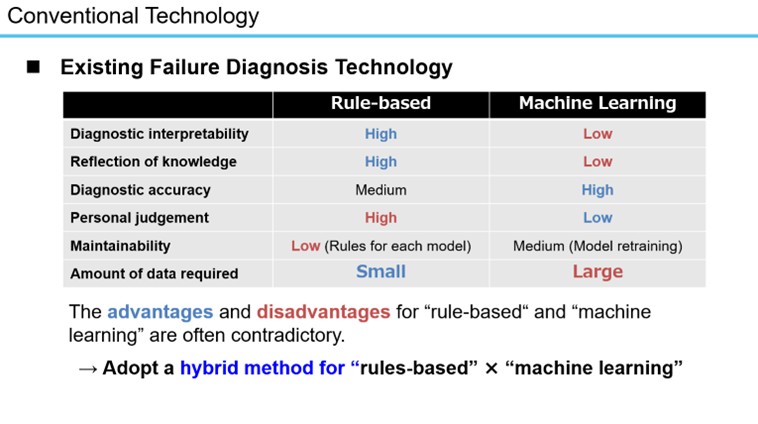 Advantages and disadvantages of rule-based and machine learning are well-balanced and complementary.
Tominaga: Well, at Daikin, we offer a variety of functions, services, and systems depending on the maintenance contract agreement, and these maintenance services are tailored-made to provide customers with both comfort and peace of mind.
To achieve even higher quality, we are confronted with the following four challenges:
● During the hot summer months, several customers may simultaneously experience breakdowns, extending the response time longer than usual.
● The technical ability to diagnose and repair problems varies according to the experience of the SE.
● Experienced SEs are getting older and leaving the workforce.
●Depending on the breakdown, there may be a need to diagnose the problem on-site, arrange for parts, and reschedule the repair at a later date.
Therefore, rule-based failure diagnosis can only be applied for a limited range of situations, and applying it to a wider range can result in high operational costs. Incidentally, rule-based failure diagnosis requires different rules for each model.
――Don't air conditioners have error codes that tell the SEs what the problem is?
Tanabe: Yes, air conditioners have "error codes" that indicate error type, but these only indicate that a specific sensor value is outside its threshold level. The SE has to investigate the actual phenomenon and its cause.
For example, suppose that a thermistor generates an error code. All we can know from this is that the thermistor's value (temperature) is outside the normal range. The thermistor itself may be faulty, or the thermistor may be showing an error code due to another malfunction, such as running out of gas.
This means that the cause of the anomaly may be in a different area than the symptoms, or a single anomaly may be caused by multiple factors. SEs must use their experience and knowledge to diagnose the cause of the failure.
Two Systems with Complementary Characteristics: Reason for a "Hybrid" System
――What was your first step in development of the hybrid system?
Tominaga: You first need to access the vast amounts of data available in the market. Fortunately, Daikin offers its "AirNet Service System," a remote monitoring service for commercial air conditioners. For over 30 years since the service began, Daikin has been accumulating operational data for contracted equipment. Having worked with this data for many years now, we have accumulated enough knowledge (domain knowledge) to correlate the information from each sensor with actual failures. However, expressing all of this information in a rule-based manner and automating it would carry extremely high operating costs.
――So how did you overcome the high operating costs?
Tanabe: The breakthrough involved machine learning. We had initially speculated whether a hybrid model of rule-based and machine learning could achieve the necessary processing. For example, rule-based systems are better at diagnostic interpretability and reflecting knowledge, whereas machine learning is better at diagnostic accuracy. This means that the weaknesses of one can be compensated for by the strengths of the other, suggesting a complementary relationship between rule-based systems and machine learning.
Tominaga: You first need to access the vast amounts of data available in the market. Fortunately, Daikin offers its "AirNet Service System," a remote monitoring service for commercial air conditioners. For over 30 years since the service began, Daikin has been accumulating operational data for contracted equipment. Having worked with this data for many years now, we have accumulated enough knowledge (domain knowledge) to correlate the information from each sensor with actual failures. However, expressing all of this information in a rule-based manner and automating it would carry extremely high operating costs.
――So how did you overcome the high operating costs?
Tanabe: The breakthrough involved machine learning. We had initially speculated whether a hybrid model of rule-based and machine learning could achieve the necessary processing. For example, rule-based systems are better at diagnostic interpretability and reflecting knowledge, whereas machine learning is better at diagnostic accuracy. This means that the weaknesses of one can be compensated for by the strengths of the other, suggesting a complementary relationship between rule-based systems and machine learning.
Rule-based systems have the advantage of being able to immediately incorporate knowledge into decision-making criteria (rules) and require only a small amount of data.
However, one of their disadvantages includes an incompatibility with complex conclusions. Conversely, machine learning has high diagnostic accuracy, but their algorithms are black boxes, making it difficult for humans to fully understand the logic behind it.
Also, with rule-based systems, humans can manipulate the reference values when incorporating knowledge gained from actual measurements, but with machine learning, even if correct answer data is loaded, humans cannot understand how it will be used within the machine learning model. Consequently, we came up with the idea of combining rule-based and machine learning in the form of our Hybrid AI Failure Diagnosis technology.
Advantages and disadvantages of rule-based and machine learning are well-balanced and complementary.
Hybrid AI Failure Diagnosis Structure Creates Three Points of Differentiation
――So, it's actually two systems with separate roles playing to their respective strengths, isn't it?
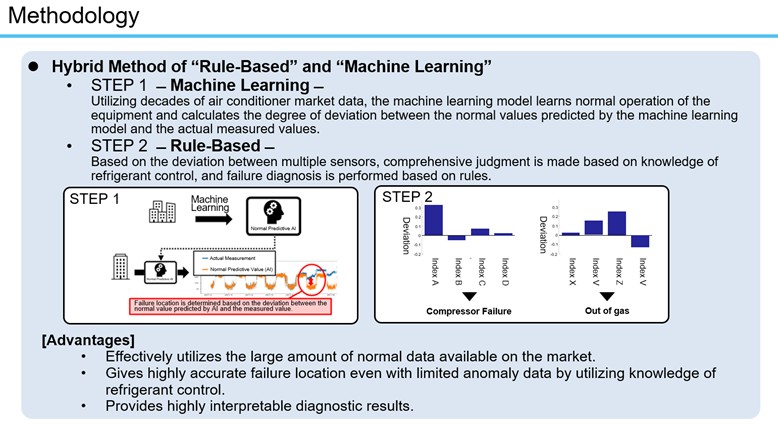 Developing failure diagnosis algorithms by separating and combining the roles of machine learning and rule-based systems
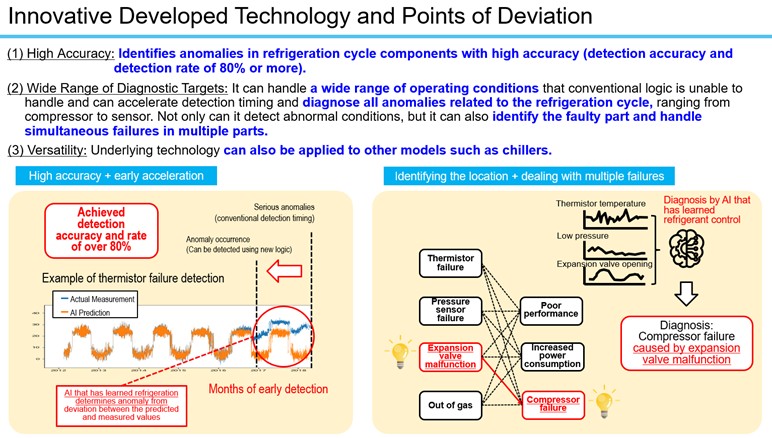 Anomalies are detected based on deviations between the predicted value and the reference value, which creates three points of differentiation.
Tanabe: Yes, that right. The failure diagnosis process follows two basic steps:
● STEP 1: Predicting Normal Sensor Values Using Machine Learnin
● STEP 2: Performing Failure Diagnosis by Comparing Actual and Predicted Values
First, in STEP 1, machine learning is used to predict normal values and compare them with actual measurements to determine the deviation. This model is a regression model that uses normal data as training labels. The normal data was created using our accumulated AirNet data. Then, in STEP 2, rules are used to determine the cause of the failure based on the balance of deviations for each sensor. When determining these rules, we made extensive use of our accumulated domain knowledge for refrigerant control.
Tominaga: Instead of the hybrid method used here, there is also a method of building a classification model that uses normal and abnormal data as training labels. In this case, due to the characteristics of machine learning, large amounts of both normal and abnormal data are required. However, while there is a huge amount of normal data in the market, there is not much abnormal data.
Artificially creating abnormal data was also considered, but this would require covering a wide variety of failure modes, such as running out of gas, thermistors, compressors, and motor-operated valves, and creating the amount of data required for supervised learning would require an enormous amount of work. For this reason, we came up with this hybrid method, which makes use of the vast amount of normal data that exists while also enabling highly accurate failure diagnosis with a small amount of abnormal data.
Developing failure diagnosis algorithms by separating and combining the roles of machine learning and rule-based systems――How long has the hybrid system been operating and how is it different from similar programs?

Tominaga: Once we successfully developed the Hybrid AI Failure Diagnosis system, we released this algorithm in February 2025. Although it has only been in operation for about four months, we are already seeing steady results within the company and is distinguishing itself on three points: high accuracy, wide range of diagnostic coverage, and horizontal development.
Previous rule-based failure diagnosis methods were unable to fully track changes in ambient temperatures and operating conditions, but Hybrid AI Failure Diagnosis uses machine learning to track these changes, improving the comprehensiveness of failure diagnosis.
Tanabe: Another benefit is that it makes it easier to expand the scope of diagnostics. With rule-based failure diagnosis, it was necessary to define rules for each model. However, because machine learning models can absorb the differences between models and make judgments, there is no longer a need to separate rules based on each model.
Hybrid AI Failure Diagnosis is something that we can look forward to seeing further developments in the future. It was originally developed for the VRV series multi-split air conditioner for commercial buildings, but the model's versatility makes horizontal development possible to other models. Therefore, it can also be deployed in the SkyAir series, which is intended for commercial use but smaller than the VRV series, as well as in residential air conditioners.
Anomalies are detected based on deviations between the predicted value and the reference value, which creates three points of differentiation.Significance of Hybrid AI Failure Diagnosis and Potential for Overseas Expansion
――What on-site advantages does Hybrid AI Failure Diagnosis bring SEs?
Tominaga: Hybrid AI Failure Diagnosis offers several benefits. First, because the cause of the failure is identified before an SE is dispatched to the site, repair time is significantly reduced. Also, if parts are in stock, repairs can be completed in one call.
This technology aims to reduce labor and costs, not only in the short term but also in the long term. Therefore, when dispatched to replace a certain part, the SE can also detect deterioration of other parts and replace them at the same time, which not only helps prevent breakdowns, but it also reduces the number of SEs dispatched on-site.
Customers who use Daikin air conditioners greatly value the high quality of our maintenance service, so we believe that Hybrid AI Failure Diagnosis will further increase customer satisfaction.
――Could Hybrid AI Failure Diagnosis be used in an overseas country like India?
Tanabe: Certainly. In fact, we have plans to develop the Hybrid AI Failure Diagnosis for India as well. To give you an idea of the environment in India, there are many days when the temperature exceeds 40°C, so if your air conditioner breaks down there, the impact tends to be much greater than in Japan.
Combine the high temperatures with the high level of dust in the air, and you get a higher risk of equipment failure. This is why the percentage of customers who have maintenance contracts in India is greater than in Japan. Since many customers are already proactive about maintenance, we hope they will embrace Hybrid AI Failure Diagnosis.
A Challenge from Absolute Zero Creates Potential for Social Impact
――Is it true that Daikin Information and Communications Technology College (DICT) provided you with a completely new specialty than what you majored in at university?
Tominaga: As a student, I studied and researched electrical circuits and materials, so I had no background in AI or much experience writing programs before entering Daikin Information and Communications Technology College (DICT). At DICT, I learned a wide range of subjects, including machine learning, AI, statistics, algorithmic data analysis, cloud computing, and programming. What I learned at DICT is definitely being put to good use in this development. What's more, the number of information-related personnel in related departments within the company (After Sales Service Division) who are DICT graduates is increasing, which has made it possible for us to collaborate even more smoothly.
Tanabe: When I was a student, I studied energy resources, such as oil and natural gas, along with metallic materials. I also had experience culturing cells. So, like Tominaga, the things that I learned at DICT are directly applicable to my current job. I also had the opportunity to experience practical training in which I identified problems within the company, planned a business, and created a system. Not having studied business as a student, I found learning about development with profitability in mind to be a valuable experience.
――What type of social impact do you anticipate with Hybrid AI Failure Diagnosis?
Tominaga: In recent years, there's been a shortage of skilled human resources in all industries, and the air conditioning equipment industry is no exception. For Daikin, our dedicated SEs have been able to preserve our stellar reputation for maintenance quality with their unsurpassed on-site support.
However, as the number of air conditioners on the market increases with no corresponding improvement in the shortage of human resources, guaranteeing our high quality may prove difficult. That'll be when the Hybrid AI Failure Diagnosis is really put to the test and can demonstrate its true value. Even with only a small number of people, it ensures that high-quality failure diagnosis can still be performed.

Tanabe: I also believe that the labor shortage is a serious problem and an urgent issue that needs to be resolved. The Hybrid AI Failure Diagnosis technology that we developed is just the type of innovation can provide a major breakthrough.
Not only will it reduce the workload of in-house system engineers, but it will also free up time for more value-added tasks, such as proposing comprehensive operational improvements for air conditioners that include preventive maintenance, energy savings, and legal compliance for even greater customer satisfaction.
Colleagues Challenging Together in Corporate Culture That "Recognizes Those Who Stand Out and Doesn't Criticize Forward-Looking Failures"
――What did you find appealing about the Technology and Innovation Center (TIC)?
Tominaga: Daikin has R&D centers around the world, but the Technology and Innovation Center (TIC) is the global control tower for research and development. This allows us to collaborate with various countries and gives us the opportunity to actually visit them. That's what makes the TIC so appealing.Currently, TIC is training many development human resources, including those in the information field. As one of those people, I would like to actively pursue work overseas.
Tanabe: The opportunity to take on big projects on a global scale appeal is what I find appealing about TIC. In addition to our information system human resources like us, there is a wide range of talented people in the fields including mechanical engineering and simulations. Going forward, we will actively build connections with as many people as possible and demonstrate the synergies that are unique to Daikin.
――Do you have a message for future colleagues?
Tominaga: We are currently in the stage of actively investing in the digital field across the entire company, making it the perfect environment for anyone who wants to take on new challenges using data in the digital field. Daikin also has a culture of "recognizing those who stand out and doesn't criticize forward-looking failures." Although there are certain tasks assigned to you, once you have completed them, you can proactively propose projects to your superiors that you would like to work on.
Tanabe: It's important not only to complete the tasks you're assigned but also to show your individuality. I've even suggested it to my superiors and been able to attend conferences and overseas business trips. There are an increasing number of young people at TIC, so I'm looking forward to taking on new challenges together with people who are full of a spirit for adventure.
※Information and profiles are current at the time of the interview.
Jun Tominaga
Technology and Innovation Center
Joined company: April 2019 Hometown: Hyogo Prefecture
Technology responsible for: Failure diagnosis technology using IoT and AI technologies
I want to utilize air conditioning IoT data to take on the challenge of creating after sales service that becomes the most trusted around the world by both customers and on-site workers.
Technology and Innovation Center
Joined company: April 2019 Hometown: Hyogo Prefecture
Technology responsible for: Failure diagnosis technology using IoT and AI technologies
I want to utilize air conditioning IoT data to take on the challenge of creating after sales service that becomes the most trusted around the world by both customers and on-site workers.
Yusuke Tanabe
Technology and Innovation Center
Joined the company: April 2021 Hometown: Okayama Prefecture
Technology responsible for: Failure diagnosis technology using IoT and AI technologies
I want to create new value from data and contribute to the realization of "non-stop air conditioning" that always provides comfortable air.
Technology and Innovation Center
Joined the company: April 2021 Hometown: Okayama Prefecture
Technology responsible for: Failure diagnosis technology using IoT and AI technologies
I want to create new value from data and contribute to the realization of "non-stop air conditioning" that always provides comfortable air.
Related article